
Article Type: Clinical Image, Volume 3 Issue 1
*Corresponding author: Victoria Tischer Sawka
Universidade Estadual do Oeste do Paraná (UNIOESTE), Campus Francisco Beltrão, Paraná, Brazil
Email: victoriasawka@gmail.com
Received: Mar 13, 2026 Accepted: Apr 02, 2026 Published: Apr 09, 2026
Citation: Sawka VT, Wendt GW. Herlyn–Werner–Wunderlich syndrome in an adolescent with severe dysmenorrhea. Ann Case Rep Med Images. 2026; 3(1): 1079.
Copyright: Sawka VT et al. © All rights are reserved
A 16-year-old nulliparous female with a history of severe dysmenorrhea since menarche (age 14) presented with worsening lower abdominal pain. Her cycles were irregular (24-30 days), with normal flow lasting five days. After four cycles, she developed severe dysmenorrhea, associated with nausea, dizziness, and functional impairment. Her symptoms were unresponsive to NSAIDs. MRI revealed a didelphic uterus (Figure 1) and an incomplete vaginal septum (Figure 2). Imaging findings, along with a history of right renal agenesis (Figure 3), led to a diagnosis of Herlyn-Werner-Wunderlich syndrome. She started continuous drospirenone 4 mg therapy to induce amenorrhea. She opted to continue hormonal therapy instead of corrective surgery. This rare Müllerian anomaly can cause hematometra and endometriosis, making early diagnosis crucial. Continuous hormonal suppression offers an effective alternative to surgery for symptom management and pain relief.
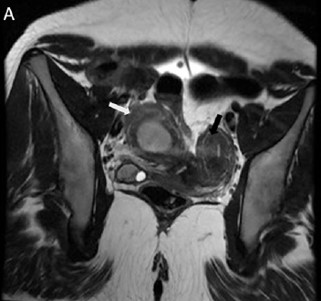
Figure 1: Black arrow indicates the left hemicorpus; white arrow, the distended right hemicorpus.
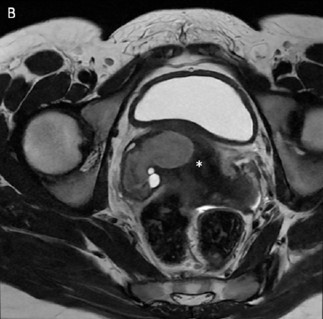
Figure 2: Asterisk indicates an incomplete vaginal septum.
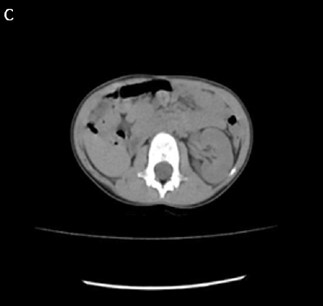
Figure 3: Total abdominal CT indicates right renal agenesis.