Article Type: Clinical Image, Volume 2 Issue 2
*Corresponding author: Haixia Xing
Department of General Dentistry, Peking University School and Hospital of Stomatology & National Center for Stomatology & National Clinical Research Center for Oral Diseases & National Engineering Research Center of Oral Biomaterials and Digital Medical Devices, Beijing 100081, China.
Email: helenxing83@yahoo.com
Received: Oct 09, 2025 Accepted: Nov 12, 2025 Published: Nov 19, 2025
Citation: Le D, Xing H. Combinations of nifedipine and cyclosporine induced gingival enlargement. Ann Case Rep Med Images. 2025; 2(2): 1050.
Copyright: Xing H et al. © All rights are reserved
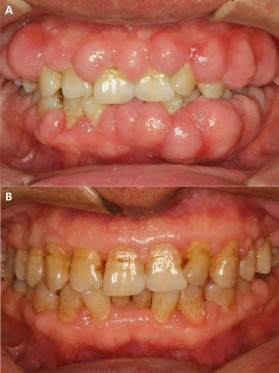
A 52-year-old male complained with gum overgrowth for ten years. He took immunosuppressants (cyclosporine) for post kidney transplant treatment for twenty years. He took nifedipine sustained-release tablets to control blood pressure. At clinical observation, obvious firm gingival hyperplasia affected both labial and lingual papillary region, with lobular, globular and nodular appearance, covering more than half of dental surfaces (Figure A). The gingival enlargement also accompanied by oedema and bleeding, abundant dental plaque deposits. Nifedipine, cyclosporine, and phenytoin commonly contributed to medicine-induced gingival enlargement. In this case, associated with poor oral hygiene conditions, cyclosporine and nifedipine synergistically increased the severity of gingival enlargement. They both decreased the activity of collagenase, resulting in collagen synthesis exceeding degradation. The patient was scheduled gingivectomy after initial periodontal therapy. Pathology examination demonstrated excessive collagen accumulation accompanied by inflammatory infiltrates. Tacrolimus was discharged to replace cyclosporine. The gingiva maintained normal appearance two years after surgery (Figure B)