
Article Type: Short Report, Volume 2 Issue 2
*Corresponding author: Ilham Snoussi
Department of Dermatology and Venereology, Mohammed VI University Hospital, La Nouvelle Ville Ibn Batouta, Tangier, Morocco.
Email: ilham.snoussi@usmba.ac.ma
Received: Jul 16, 2025 Accepted: Aug 08, 2025 Published: Aug 15, 2025
Citation: Snoussi I, El Jouari O, Gallouj S. Chronic tinea cruris caused by Trichophyton indotineae in a healthy young woman in Morocco: A case report. Ann Case Rep Med Images. 2025; 2(2): 1033.
Copyright: Snoussi I et al. © All rights are reserved
Introduction: Trichophyton indotineae is an emerging dermatophyte species that has become a significant cause of chronic superficial fungal infections, especially in endemic regions. Its global spread and resistance to terbinafine pose challenges to effective treatment and highlight the need for precise diagnostics.
Case: We describe a 30-year-old healthy Moroccan woman with a two-year history of chronic pruritic erythematous plaques in the intergluteal and inguinal areas. Direct microscopy and fungal culture identified dermatophyte infection, while molecular sequencing of the ITS region confirmed T. indotineae. The patient did not respond to topical antifungals but achieved full resolution after four weeks of oral itraconazole therapy.
Discussion: T. indotineae, part of the T. mentagrophytes complex, is often resistant to terbinafine due to mutations in the squalene epoxidase gene, explaining treatment failures with standard topical therapies. Molecular identification is essential for guiding appropriate systemic antifungal therapy. Itraconazole remains effective in managing infections caused by terbinafine-resistant strains.
Conclusion: This case highlights the emerging clinical importance of T. indotineae outside endemic areas, the critical role of molecular diagnostics, and the therapeutic value of itraconazole in chronic, treatment-resistant dermatophytosis.
Keywords: Trichophyton indotineae; Dermatophytosis; Terbinafine resistance; Itraconazole; Molecular identification; Chronic superficial fungal infection.
Particularly in endemic areas, Trichophyton indotineae is a newly discovered dermatophyte species that is becoming more well acknowledged as a primary contributor to superficial fungal infections, such as tinea capitis. Due to worldwide travel and migration, this anthropophilic fungus, which was first discovered on the Indian subcontinent, has spread around the world. T. indotineae is distinguished from other common agents like T. tonsurans or M. audouinii by its resistance to terbinafine, which makes treatment procedures more difficult and increases the likelihood of therapeutic failures. It is mostly spread from person to person and is frequently made easier by unsanitary living conditions and crowded living arrangements. The need for enhanced antifungal stewardship and updated diagnostic techniques is highlighted by the rising prevalence of T. indotineae-related infections, particularly in areas where conventional therapies might not work.
A 30-year-old Moroccan woman who had no past medical history came in with a persistent, itchy dermatosis that had been developing for two years. The illness began as a little, scaly, erythematous plaque in the intergluteal fold and gradually spread to the upper thighs and inguinal areas.
Bilateral, symmetrical erythematous plaques with fine peripheral scaling and elevated, active borders were found during clinical examination. These plaques extended from the intergluteal region to the medial thighs, avoiding the vulva. Neither the scalp nor the nails were affected (Figures 1 & 2).
A dermatophyte infection was confirmed by direct microscopic analysis of skin scrapings using 40% potassium hydroxide (KOH), which showed branched, septate hyaline hyphae. Lactrimel agar was used for fungal cultures, which were then incubated at 28°C. A powdery, beige-pink colony formed after 14 days. The Trichophyton mentagrophytes complex is characterized by septate hyphae, spiral hyphae, clustered microconidia, and thin-walled macroconidia, as shown in the lactophenol cotton blue microscopic study at ×400 magnification.
The isolate was confirmed to be Trichophyton indotineae through molecular identification using sequencing of the Internal Transcribed Spacer (ITS) region of rDNA.
Prior to this, the patient had not shown any clinical improvement from topical antifungal medications purchased over-the counter. Systemic antifungal medication with oral itraconazole (100 mg twice day for four weeks) was started in conjunction with suggested hygiene practices according to the infection’s chronicity and the species that was detected. Within three weeks, there was a noticeable clinical improvement, and after a month of treatment, there was total resolution.
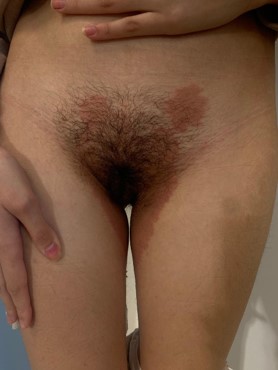
Figure 1: Erythematous, scaly, well-demarcated plaques with central clearing affecting the inguinal folds bilaterally, suggestive of chronic tinea cruris.
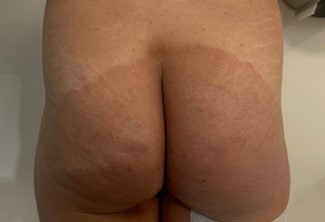
Figure 2: Large, erythematous, scaly plaque with well-demarcated borders and central clearing extending across the gluteal region.
Within the T. mentagrophytes group, Trichophyton indotineae is a newly discovered pathogen that is increasingly linked to extensive and persistent dermatophytosis, especially in people who do not have underlying immunosuppression. Through molecular research, it was shown that T. indotineae was the source of the patient’s persistent pruritic dermatosis, which was clinically suggestive of tinea cruris.
This species is characterized by a decreased sensitivity to terbinafine, which is frequently brought on by point mutations in the squalene epoxidase gene. The therapeutic failure seen with previous topical antifungal therapies in our patient is probably explained by this resistance. When oral itraconazole was started due to the chronic nature of the lesions and the discovery of T. indotineae, there was a noticeable clinical improvement in three weeks and a full resolution in one month. In areas where terbinafine resistance is suspected or verified, itraconazole is still advised as a therapeutic option.
Species-level identification, ideally using molecular methods, is still essential even though antifungal susceptibility testing is not often available in the majority of clinical settings due to technological restrictions. It offers information on the potential cause and epidemiology of infection and aids in directing focused therapy. Our case supports the use of systemic antifungal therapy based on species identification and emphasizes the significance of taking T. indotineae into account in chronic, treatment-resistant dermatophytoses, even outside of typically endemic locations.
Even outside of its native endemic regions, Trichophyton indotineae is becoming a more significant cause of chronic and treatment-resistant dermatophytosis, as demonstrated by this instance. Molecular techniques for accurate species identification are crucial for directing successful treatment, particularly when antifungal resistance is present. Early detection can help avoid long-term morbidity and transmission, and oral itraconazole is still a useful therapeutic option.
Ethical form: This study received no funding, and there are no potential conflicts of interests with respect to the research, authorship, and/or publication of this article.
Declaration of competing interest: There are none.