
Article Type: Short Report, Volume 2 Issue 1
*Corresponding author: Luyao Ma
Department of Neurosurgery, Faculty of Medicine, Juntendo University, Japan.
Email: maluyao19971219@163.com
Received: Dec 20, 2024 Accepted: Jan 15, 2025 Published: Jan 22, 2025
Citation: Yuxiao Z, Luyao M. A rare case of alcohol consumption after roxithromycin presenting as suspected myocarditis. Ann Case Rep Med Images. 2025; 2(1): 1012.
Copyright: Luyao M et al. © All rights are reserved
Disulfiram-like reactions occur when certain antibiotics are combined with alcohol, and the specific properties of different antimicrobial classes may lead to varying clinical outcomes. Roxithromycin, a macrolide antibiotic commonly prescribed for respiratory and mycobacterial infections, has not been clearly identified as a trigger for disulfiram-like reactions when combined with ethanol. Here, we present a case of a 70-year-old patient who developed a disulfiramlike reaction, characterized by chest pain, after consuming alcohol while taking roxithromycin. This report highlights the need for further investigation into the potential interaction between roxithromycin and alcohol.
Keywords: Suspected myocarditis; Alcohol consumption; Roxithromycin; Optical Coherence Tomography; Disulfiram-like reaction.
A 70-year-old man presented with chest pain, facial flushing, sweating, fatigue, and dizziness following the intake of roxithromycin and a small amount of alcohol. The chest pain lasted approximately 10 minutes and was relieved by rest after taking nitroglycerin. He was admitted to our hospital in September 2022 for further evaluation and management.
The patient had a five-year history of well-controlled hypertension and diabetes mellitus. He denied any prior history of structural heart disease or arrhythmias. Upon admission, his vital signs were stable, and physical examination findings were unremarkable. Laboratory tests, including acute myocardial enzyme and troponin levels, showed no significant abnormalities.
Electrocardiogram (ECG) findings revealed sinus rhythm with ST-segment elevation in leads II, III, and aVF, along with minimal widespread ST-segment depression and T-wave inversion in leads V2–V6 and aVL. These findings suggested acute pericarditis and anterior wall ischemia. The patient’s symptoms were subsequently resolved. Emergency coronary angiography and intravascular imaging were performed to investigate the cause of his chest pain.
Coronary angiography revealed a Thrombolysis in Myocardial Infarction (TIMI) flow grade of 3, approximately 70% stenosis in the Right Coronary Artery (RCA), and the presence of a myocardial bridge in the Left Anterior Descending artery (LAD). To further evaluate the coronary pathology, intravascular Optical Coherence Tomography (OCT) was conducted. The OCT findings showed no thrombus within the lumen, with lipid deposition occupying approximately 170° of the vessel circumferences. Although macrophage infiltration, cholesterol crystals, micro vessels, and other high-risk features were identified, the fibrous cap thickness measured 320 μm, indicating stable plaque.
The patient’s ECG showed no significant changes following intervention. He was discharged the next day with secondary preventive treatment according to current guidelines. At followup, no adverse events were reported.
This case represents the first reported instance of a disulfiram-like reaction triggered by alcohol consumption following roxithromycin administration. Emergency coronary angiography combined with intravascular imaging was performed to provide a comprehensive evaluation of coronary lesions. Despite significant luminal narrowing in the RCA, intravascular imaging revealed stable plaque characteristics. Given the resolution of the patient’s symptoms and the imaging findings, Percutaneous Coronary Intervention (PCI) was not recommended. Instead, guideline-directed medical therapy was initiated, reducing the risks of complications such as stent restenosis and thrombosis.
This case underscores the importance of intravascular imaging in distinguishing stable from unstable coronary plaques, particularly in patients with atypical presentations. It also highlights the need for awareness of potential drug–alcohol interactions, such as disulfiram-like reactions, during clinical practice.
Cephalosporin-alcohol interactions can trigger disulfiramlike reactions, manifesting as chest pain, palpitations, shortness of breath, and chest tightness, with severe cases potentially leading to myocardial infarction. However, disulfiram-like reactions caused by roxithromycin, a macrolide antibiotic, are exceedingly rare. We report the case of a 70-year-old patient who experienced a disulfiram-like reaction and chest pain after consuming alcohol in conjunction with roxithromycin.
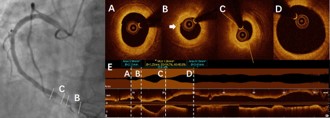
Figure 1: Angiogram (upper left) showed an approximately 70% stenosis in the distal Left Anterior Descending artery (LAD). Optical coherence tomography (upper right) images of culprit lesions. Serial Optical Coherence Tomography (OCT) cross-sectional images from distal to proximal (A–D) of the culprit lesion indicated no visible thrombus. (A) Lumen area was 9.13 mm² at distal reference. (B) Minimal lumen area was 1.26 mm². The minimum thickness of the fibrous cap (white arrows) was up to 310μm. (C) Lipid deposit occupies≈170° in circumference (yellow dotted curves). (D) Lumen area was 3.50 mm² at proximal reference.