
Article Type: Letter to Editor, Volume 1 Issue 1
*Corresponding author: Argyri Petrocheilou
Cystic Fibrosis Department, Agia Sofia Children’s Hospital, Athens, Greece.
Email: apetroch@gmail.com
Received: Aug 15, 2024 Accepted: Sep 16, 2024 Published: Sep 23, 2024
Citation: Petrocheilou A, Zarafonitis G, Loukou I. Can nail brittleness be an adverse effect of Elexacaftor/Tezacaftor/ Ivacaftor?. Ann Case Rep Med Images. 2024; 1(1): 1008.
Copyright: Petrocheilou A et al. © All rights are reserved
Keywords: Cystic fibrosis; CFTR; Nail brittleness; Elexacaftor; Tezacaftor; Ivacaftor.
Recent advances in cystic fibrosis therapeutics have resulted in the development of CFTR modulators that have led to great improvements in CF care. Novel adverse effects are still being reported. A case of brittle nails that were reported after initiation of treatment with Elexacaftor/Tezacaftor/Ivacaftor (ETI) is presented here. The parents have provided informed consent for this case presentation.
The case of a 6-year-old girl who reported nail exfoliation one month after ETI initiation is presented. The child and her family reported new-onset nail exfoliation (Figures 1a and 1b), along with improvements in cough and appetite, following ETI initiation. As the genotype is F508del/F508del, the patient was previously receiving lumacaftor/ivacaftor without ever noticing nail exfoliation. No other adverse effects were reported. Additionally, no other new medications were prescribed to coincide with the nail exfoliation, and there were no recent CF exacerbation hospitalizations. The child’s growth is within normal limits (weight is at the 88th, height at the 94th and BMI at the 69th percentile for her age), and vitamin levels have consistently remained within acceptable range. On physical examination, a few crackles were heard bilaterally, and nail clubbing with superficial granulation of nail keratin was noted. Hydrating nail lotion was prescribed by the dermatologist and the exfoliation resolved.
A similar case of nail exfoliation was noted in a 13-year-old boy two years after the initiation of ETI. The patient’s genotype is also F508del/F508del, and no exfoliation was noted with prior treatment using lumacaftor/ivacaftor or tezacaftor/ivacaftor. At the time of presentation, the association with ETI was not clear, but it raises the question of whether nail exfoliation can be related to ETI treatment.
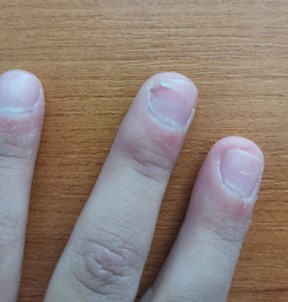
Figure 1: Fingernail exfoliation.
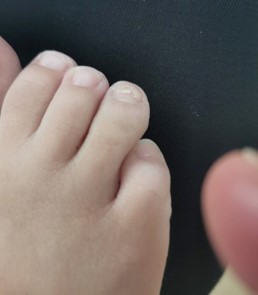
Figure 2: Toenail exfoliation.
Brittle nails can be either idiopathic or secondary to systemic inflammation or nail conditions, infections, trauma, or general conditions such as trace element or vitamin deficiencies [1]. Idiopathic brittle nail syndrome is a benign condition more commonly seen in middle-aged women and is usually related to contact with chemicals or detergents and frequent immersion in water [1]. Professional manicures have also been linked to nail brittleness [1]. Additionally, there appears to be a familial predisposition to brittle nails.
Medications can also be involved in the pathogenesis of this condition. The water content of nails was also thought to contribute to the development of brittle nails. A study showed that the water content of normal nails is 11.9%, whereas that of brittle nails is 12.48%, even though this difference was not statistically significant [2].
In both studies and clinical practice, it has been demonstrated that ETI leads to reductions in sweat chloride by modulating CFTR channel function [3]. The sweat chloride reduction with ETI is more pronounced than with Lumacaftor/Ivacaftor or Tezacaftor/Ivacaftor. This raises the question of whether nail sodium, chloride, and water content in cystic fibrosis patients receiving ETI could potentially be linked to nail brittleness.
Conflict of interest: Nothing to disclose.
Statement on consent for publication: All authors have seen and approved the manuscript and consent for publication
Statement on ethical approval and informed consent: Informed consent has been given by the parents. No ethical approval required as per hospital requirements.